Applied work

Software for AI agents that answer to someone

The Machineforce runs AI agents with accountability built in: each one has a role, someone it answers to, and limits it can’t go past.

The platform

Two parts, one idea

in production

Machineforce Launch

The front door. One sign-in for every Machineforce app, and it puts each person where they belong: their own Machineforce, their organization’s, or both.

A first sign-in is a first day: it sets the person up before it lets them in.
in production · hardware on the bench

Machineforce Control

Where AI agents are run. Every agent has a role, someone it answers to, and limits it can’t go past. Operators approve what needs approving, and agents learn on the job from the corrections they get.

When it matters, Control hands the decision to the lab’s own chip*, so the limits hold even if the software around it doesn’t. Everywhere else, Control enforces the same rules in software.

How it works

The parts, the workflows and the data

The parts

How the parts fit

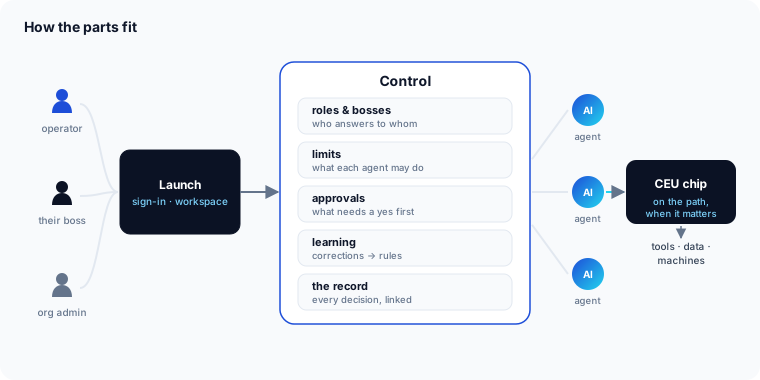
People sign in once, through Launch, and land in the right workspace: their own, their organization’s, or both.

Control is where the rules live: who each agent answers to, what it may do, what needs a yes first, what it has learned, and the record of everything it did.

Agents do the work in the tools and data they were given. When the stakes are high, the lab’s own chip sits on the path.

Operators, bosses and admins sign in through Launch; Control holds roles, limits, approvals, learning and the record; agents act on tools and data, with the CEU chip on the path when it matters
The workflow

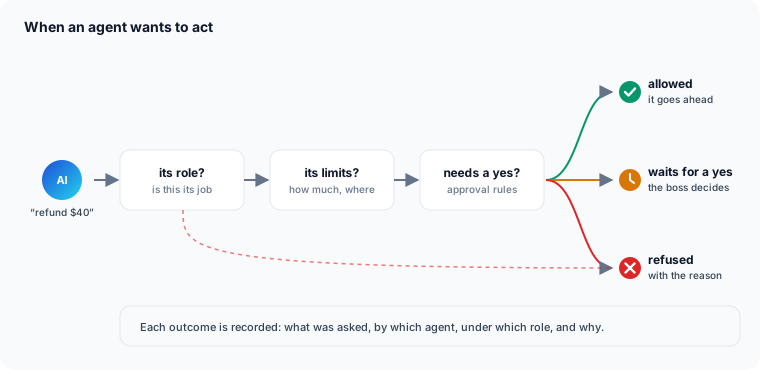
When an agent wants to act

Every action an agent proposes is checked against three things: is this its job, is it within its limits, and does it need someone to say yes first.

The answer is one of three: it goes ahead, it waits for the boss, or it is refused with a reason the operator can read.

Whatever the answer, it is recorded.

An agent asks to act; Control checks its role, its limits and whether the action needs a yes; it is allowed, waits for the boss, or is refused with a reason, and each outcome is recorded
The workflow

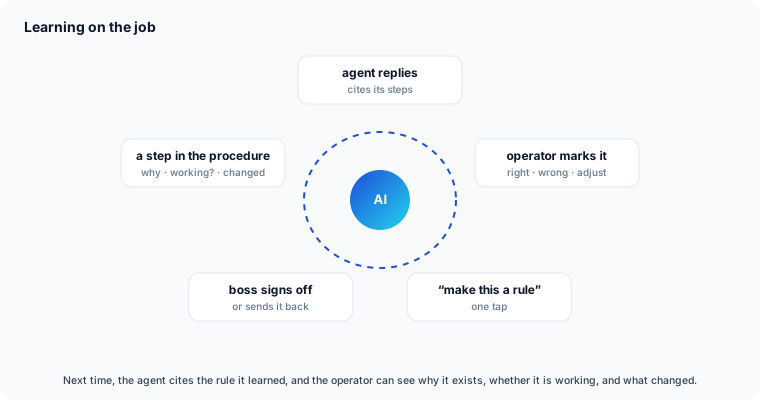
Learning on the job

Agents get better the way new staff do: by being corrected. An operator marks a reply right, wrong or “adjust”, and one tap turns a correction into a proposed rule.

The agent’s boss signs it off or sends it back. Approved rules become steps in the agent’s procedure, and the agent cites them by name next time.

No retraining. Every rule shows why it exists, whether it is working, and what changed.

The learning loop: the agent replies citing its steps; the operator marks it; one tap makes it a rule; the boss signs off; it becomes a step in the procedure, which the agent cites next time
The workflow

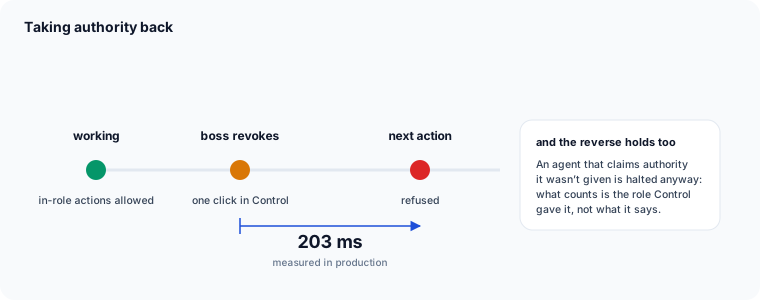
Taking authority back

Authority is something a person gives, so a person can take it away. When a boss revokes an agent’s authority in Control, its next action is refused — 203 ms later, measured on the live system.

It works the other way too: an agent that claims authority it was never given is halted anyway. What counts is the role Control gave it.

A timeline: an agent working, its boss revokes its authority, and its next action is refused 203 milliseconds later; an agent claiming authority it wasn’t given is halted anyway
The data

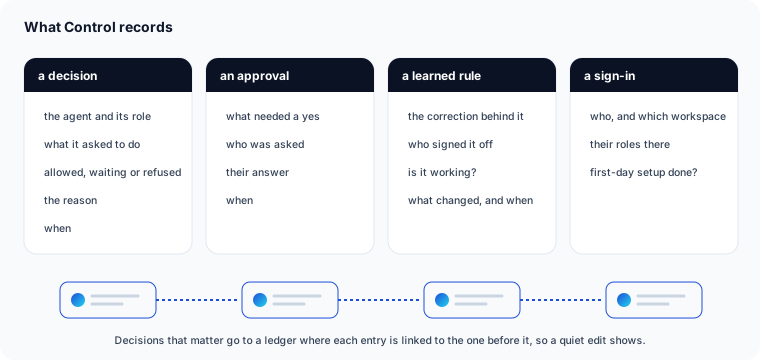
What Control records

Control keeps the facts needed to answer “who let this happen, and why?” — for every decision, every approval, every learned rule and every sign-in.

Decisions that matter go to a ledger where each entry is linked to the one before it, so a record can’t be quietly changed after the fact.

What Control records is about the work agents do and who authorized it. How it is stored is shared under NDA.

Four kinds of record Control keeps: a decision, an approval, a learned rule and a sign-in, each with its fields; decisions that matter go to a linked ledger so a quiet edit shows
Hardware

Software today, hardware where it moves

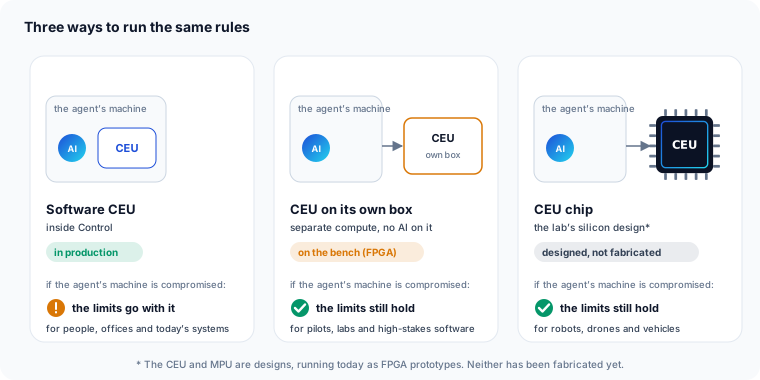
The same rules can run in three places. In software, inside Control, they protect people and today’s systems from agents that overstep, and that is how the Machineforce runs in production.

But software trusts the machine it runs on. If that machine is compromised, the limits go with it. So the checker should never run on the hardware it is checking: on its own box with no AI on it, or as a chip.

That is what autonomous robots, drones and vehicles need, because a wrong action moves something. The CEU on its own box runs on the bench today, on an FPGA board; the chip is a design.*

Three ways to run the same rules: a software CEU inside Control, in production; a CEU on its own box, on the bench; and the CEU chip, designed but not fabricated. Only the last two still hold if the agent’s machine is compromised.
Hardware

When the chip takes over

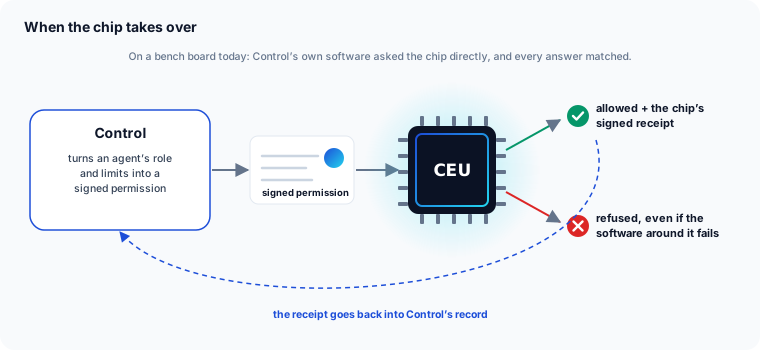
For the actions that matter most, Control turns an agent’s role and limits into a signed permission, and the lab’s CEU chip* makes the call.

An allowed action comes back with the chip’s own signed receipt, which goes into Control’s record. A refused one stays refused, even if the software around the chip fails.

On a bench board today: Control’s own software asked the chip directly, and every answer matched.

Control turns an agent’s role and limits into a signed permission; the CEU chip allows it with a signed receipt or refuses it even if the software around it fails; the receipt goes back into Control’s record
Progress

Where each part stands

Launch and Control are in production. Learning on the job and each operator’s own workspace are rolling out, and the hardware link is on the bench.

Part
Design
Built & tested
In production
Tested in production
Backed by hardware
LaunchThe front door
doneOne sign-in, roles and workspaces designed together
doneCovered by the lab’s end-to-end test library
doneLive: every Machineforce app signs in through it
doneSigned in live in every end-to-end run
ControlWhere agents are run
doneEvery agent gets a role, a boss and limits
donePermissions only shrink: 434 of 434 checks
doneLive end to end
doneAuthority revoked in 203 ms; claims an agent makes about itself ignored
in progressOn the bench: Control issues the permissions the chip enforces
Learning on the jobInside Control
doneA correction becomes a rule the agent cites
doneShown live on stage at DevFest Troy
in progressBosses sign off standing rules; rolling out
My MachineforceEach operator’s own workspace
doneAn operator’s own Machineforce, apart from their organization’s
doneFirst sign-in sends each person to the right place
doneLive, with a daily paper each operator can tune
in progressBeing tried with a first operator account
How we work

From a rule to a running agent

1

Design

What an agent must never do, written down before it is built.

2

Build & test

Every rule backed by tests, including the refusals.

3

Ship

Our own release pipeline checks each build before it goes live.

4

Test in production

The same checks, run against the live system. This is where Control is now.

5

Back with hardware

The decisions that matter, made by the chip. On the bench today.

Milestones

How far it’s come

From going live, through the tests that matter, to the chip. Filter by part, and sort newest or oldest first; each part’s lane grows toward its newest milestone.

Part
Sort
  1. Rolling outlatest
    Learning
    Bosses sign off the rules their agents learn, and each approved rule becomes a step in the agent’s procedure.

    What it means for you: The corrections you give an agent become rules your manager can approve, and the agent follows them from then on.

    learned rule✓boss signsstep 1step 2step 3step 4becomes a procedure step
  2. In production
    My Machineforce
    Every operator gets their own Machineforce, with a daily paper they can tune.

    What it means for you: You start each day in your own workspace, with a daily paper tuned to you.

    MY MACHINEFORCEa daily paper per operator
  3. Backed by hardware
    ControlCEU
    A full week of graded runs from Control to the chip: no wrong approval and no approval the chip hadn’t signed. More →

    What it means for you: For high-stakes actions, a hardware check stands behind the software, and it fails safe.

    Control26 runs · 0 false
  4. Live demo
    Learning
    Learning on the job, live on stage at DevFest Troy: one correction became a rule the agent cited on the next invoice. More →

    What it means for you: You teach an agent the way you’d teach a new hire, by correcting it once, instead of waiting for it to be retrained.

    DevFestTroyINVOICErush fee (rule)one correction, cited next time
  5. Tested in production
    Control
    An agent that claimed authority it didn’t have was halted, and a revoked agent’s next action was refused 203 ms later. More →

    What it means for you: If an agent needs to stop, it stops on its very next action, not after a sync or a restart.

    revokednext action203 ms
  6. Backed by hardware
    ControlCEU
    Control’s own software issued an agent’s permissions and asked the CEU chip on a bench board directly; every answer matched. More →

    What it means for you: The limits you set in Control are the ones the hardware enforces.

    ControlControl asks the chip directly
  7. Tested
    Control
    Permissions only shrink: every rule an operator adds narrows what an agent may do, never widens it, across 20 kinds of agent. More →

    What it means for you: Adding a rule can only make an agent safer; no rule can accidentally give it more power.

    434 / 434rules only narrow, never widen
  8. In production
    LaunchControl
    Machineforce Control went live end to end, with Launch as the single sign-in for every app.

    What it means for you: One sign-in takes you to every Machineforce app and the right workspace.

    LaunchControl, live

Results in plain language are on Findings; the chip is on Silicon.

Use it

* The CEU and MPU are designs. They run today as FPGA prototypes and have not been fabricated. Machineforce Control enforces the same rules in software today.

The Machineforce is in use with early customers. To see it or try it, visit machineforce.one or contact the lab. How it is built is shared under NDA.